Crônica · 22 de abril de 1995
Chronik · 22. April 1995
Chronicle · 22 April 1995
O dia em que mil e cento e setenta nomes voltaram
Der Tag, an dem eintausendeinhundertsiebzig Namen zurückkehrten
The day a thousand one hundred and seventy names returned
1º Encontro da Família Wermelinger · Duas Barras, Rio de Janeiro
1. Treffen der Familie Wermelinger · Duas Barras, Rio de Janeiro
1st Wermelinger Family Gathering · Duas Barras, Rio de Janeiro
Arquivo Wermelinger · afamiliawermelinger.blogspot.com
Wermelinger-Archiv · afamiliawermelinger.blogspot.com
Wermelinger Archive · afamiliawermelinger.blogspot.com
“Havia crachás na entrada. Pequenos pedaços de papel com um nome — e esse nome era suficiente.”
„Am Eingang lagen Namensschilder. Kleine Papierstücke mit einem Namen — und dieser Name genügte.“
“There were name tags at the entrance. Small pieces of paper with a name — and that name was enough.”
Havia crachás na entrada. Pequenos pedaços de papel com um nome — e esse nome era suficiente. Todo Wermelinger, descendente ou não, tinha direito a usá-lo como identificação para participar do encontro. Era o dia 22 de abril de 1995, um sábado de outono em Duas Barras, e o ginásio de esportes Sebastião José dos Santos, do Bibarrense Atlético Clube, se preparava para receber o que imaginavam ser trezentas, talvez quinhentas pessoas.
Não havia como prever o que estava por vir.
Às nove horas da manhã, a comitiva se dirigiu primeiro à Igreja Matriz de Nossa Senhora da Conceição. Aquela mesma nave de pedra e cal que tantos Wermelinger batizaram seus filhos, casaram suas filhas, velaram seus mortos. A missa de Ação de Graças soou diferente naquele dia — as vozes eram mais numerosas, os bancos mais cheios, e havia algo no ar que não era apenas o incenso. Era o peso de 175 anos sendo reconhecido coletivamente, pela primeira vez.
Depois da missa, a comitiva seguiu ao cemitério da Irmandade. Flores foram depositadas sobre os túmulos dos antepassados. Alguém parou diante de uma lápide e ficou em silêncio por um longo momento. Ninguém precisou perguntar o que sentia.
Em 1820, François Xavier Wermelinger desembarcou no Brasil com sua esposa Catharina Egglin e cinco filhos, após uma travessia que custou ao menos uma vida — João Batista Wermelinger faleceu a bordo do navio Heureux Voyage em 20 de dezembro de 1819, antes mesmo de ver a terra nova. Eles vieram de Lucerna, no cantão católico da Suíça, carregando um nome que remontava ao ano 1300 — registrado nos arquivos de Ruswil como “Wermoldingen”, derivado da “Quinta de Wermellinger” ao norte de Wolhnses.
Dedicaram-se ao desenvolvimento agropastoril das regiões de Duas Barras, Sumidouro, Cantagalo, Cordeiro e Itaocara. Não encontraram terras fáceis. A topografia era ingrata, o clima imprevisível, e os instrumentos disponíveis nada tinham do conforto europeu. Mas ficaram. E ao ficarem, plantaram raízes que nenhuma intempérie conseguiu arrancar.
Cento e setenta e cinco anos depois, seus descendentes voltavam àquele mesmo solo — não para trabalhar, mas para se reconhecer.
De volta ao ginásio, às onze e quinze, a Assembleia Geral foi aberta com a leitura de um histórico minucioso sobre a origem da família. O advogado Wálter Wermelinger da Costa — que desde 1962 pesquisava a genealogia do clã — estava à frente do evento ao lado de Humberto Marchon Fontão, técnico de laboratório aposentado. Juntos, eles haviam sonhado com aquele dia por décadas.
Esperava de trezentas a quinhentas pessoas. E acredito que haja mais de mil.
Wálter Wermelinger da Costa
Às 13h50, cinco horas após a abertura, 1.170 pessoas já haviam passado pelas roletas do local.
Estimava-se que existissem entre seis e oito mil Wermelinger no Brasil — a maioria na Região Serrana do Rio de Janeiro — e aproximadamente trezentos na Suíça, onde o ramo europeu havia perdido contato com o brasileiro desde 1819. No ginásio, questionários foram distribuídos para a montagem de um banco de dados genealógico e a construção da árvore do clã. A ideia de fundar uma associação, em Duas Barras ou em Nova Friburgo, também estava na pauta.
O almoço que reuniu o tempo inteiro
O almoço de confraternização reuniu à mesma mesa figuras proeminentes, anciãos encanecidos que brindaram com a beleza dos anos vividos estampada nos semblantes, e o membro mais novo da família: um bebê de poucos dias de vida, nascido no povoado da Boa Vista, apresentado com euforia no colo da mãe emocionada. Duas Barras, orgulhosa e engalanada, havia recebido de várias partes do país familiares e afins para a grande festa.
No palco, apresentações artísticas dos próprios descendentes. Concurso da rainha. Bingo beneficente em favor da APAE, com as crianças tendo atividades recreativas no Estádio do Bibarrense, ao lado do ginásio. Cada detalhe havia sido pensado pelos organizadores para que nada fosse esquecido.
O jornalista Jorge Marinho Falcão, ao cobrir o evento para o Correio Fluminense, escreveu:
Qualquer pessoa de bom discernimento se sentiria orgulhoso de pertencer à valorosa família Wermelinger.
Jorge Marinho Falcão · Correio Fluminense, 1995
Um homem com trinta anos de papel guardado
Wálter Wermelinger da Costa, o advogado que há trinta anos guardava papéis, cartas e certidões à espera daquele momento, sintetizou o que o encontro representava: mostrar o rejuvenescimento dos Wermelinger. E também — com a seriedade de quem conhece a fragilidade das coisas — salvaguardar aquela família dos males do tempo presente.
Às dezesseis horas, enquanto o bingo sorteava seus números e as crianças corriam pelo estádio, a cidade de Duas Barras havia feito algo que raramente uma cidade pequena consegue: devolver a uma família dispersa por gerações e continentes o senso de que havia, afinal, um lugar no mundo que era seu.
Am Eingang lagen Namensschilder. Kleine Papierstücke mit einem Namen — und dieser Name genügte. Jeder Wermelinger, ob direkter Nachfahre oder nicht, hatte das Recht, ihn als Ausweis zu tragen, um am Treffen teilzunehmen. Es war der 22. April 1995, ein Herbstsamstag in Duas Barras, und die Sporthalle Sebastião José dos Santos des Bibarrense Atlético Clube bereitete sich darauf vor zu empfangen, was man auf dreihundert, vielleicht fünfhundert Personen schätzte.
Es war nicht abzusehen, was kommen würde.
Um neun Uhr morgens zog die Versammlung zunächst zur Mutterkirche Unserer Lieben Frau von der Empfängnis. Dasselbe Schiff aus Stein und Kalk, in dem so viele Wermelinger ihre Kinder taufen, ihre Töchter heiraten, ihre Toten betrauern liessen. Die Dankesmesse klang an jenem Tag anders — die Stimmen waren zahlreicher, die Bänke voller, und etwas lag in der Luft, das nicht nur Weihrauch war. Es war das Gewicht von 175 Jahren, die zum ersten Mal kollektiv anerkannt wurden.
Nach der Messe zog die Versammlung zum Friedhof der Bruderschaft. Blumen wurden auf die Gräber der Vorfahren gelegt. Jemand blieb vor einem Grabstein stehen und schwieg lange. Niemand musste fragen, was er empfand.
1820 betrat François Xavier Wermelinger brasilianischen Boden, mit seiner Frau Catharina Egglin und fünf Kindern, nach einer Überfahrt, die mindestens ein Leben gekostet hatte — João Batista Wermelinger starb am 20. Dezember 1819 an Bord des Schiffes Heureux Voyage, noch bevor er das neue Land erblicken konnte. Sie kamen aus Luzern, dem katholischen Kanton der Schweiz, mit einem Namen, der bis ins Jahr 1300 zurückreicht — in den Archiven von Ruswil als „Wermoldingen“ verzeichnet, abgeleitet vom „Hof Wermellinger“ nördlich von Wolhnses.
Sie widmeten sich der Land- und Viehwirtschaft in den Regionen Duas Barras, Sumidouro, Cantagalo, Cordeiro und Itaocara. Sie fanden kein leichtes Land vor. Die Topographie war undankbar, das Klima unberechenbar, und die verfügbaren Werkzeuge hatten nichts vom europäischen Komfort. Aber sie blieben. Und indem sie blieben, schlugen sie Wurzeln, die kein Unwetter mehr ausreissen konnte.
Hundertfünfundsiebzig Jahre später kehrten ihre Nachfahren auf jenen Boden zurück — nicht zur Arbeit, sondern um sich zu erkennen.
Zurück in der Sporthalle, um elf Uhr fünfzehn, wurde die Generalversammlung mit der Verlesung eines ausführlichen Berichts über den Ursprung der Familie eröffnet. Der Anwalt Wálter Wermelinger da Costa — der seit 1962 die Genealogie des Klans erforschte — stand der Veranstaltung vor, an der Seite von Humberto Marchon Fontão, einem pensionierten Labortechniker. Gemeinsam hatten sie diesen Tag jahrzehntelang erträumt.
Esperava de trezentas a quinhentas pessoas. E acredito que haja mais de mil.
[„Ich habe dreihundert bis fünfhundert Menschen erwartet. Und ich glaube, es sind mehr als tausend.“]
Wálter Wermelinger da Costa
Um 13:50 Uhr, fünf Stunden nach der Eröffnung, hatten bereits 1.170 Personen die Drehkreuze passiert.
Schätzungsweise gab es zwischen sechs- und achttausend Wermelinger in Brasilien — die meisten in der Bergregion von Rio de Janeiro — und etwa dreihundert in der Schweiz, wo der europäische Zweig seit 1819 den Kontakt zum brasilianischen verloren hatte. In der Halle wurden Fragebögen verteilt, um eine genealogische Datenbank aufzubauen und den Stammbaum des Klans zu konstruieren. Auch die Idee, einen Familienverband in Duas Barras oder Nova Friburgo zu gründen, stand auf der Tagesordnung.
Das Mittagessen, das die ganze Zeit versammelte
Das Verbrüderungs-Mittagessen versammelte am selben Tisch herausragende Persönlichkeiten, ergrauter Greise, die mit der Schönheit gelebter Jahre auf dem Antlitz anstiessen, und das jüngste Familienmitglied: ein wenige Tage altes Baby, geboren im Weiler Boa Vista, auf dem Schoss der gerührten Mutter mit Begeisterung vorgestellt. Duas Barras, stolz und festlich geschmückt, hatte aus verschiedenen Teilen des Landes Verwandte und Angehörige zum grossen Fest empfangen.
Auf der Bühne, künstlerische Auftritte der Nachfahren selbst. Ein Königinnen-Wettbewerb. Eine Wohltätigkeits-Tombola zugunsten der APAE, während die Kinder Freizeitaktivitäten im Stadion des Bibarrense neben der Halle hatten. Jedes Detail war von den Organisatoren bedacht worden, damit nichts vergessen werde.
Der Journalist Jorge Marinho Falcão, der das Ereignis für den Correio Fluminense dokumentierte, schrieb:
Qualquer pessoa de bom discernimento se sentiria orgulhoso de pertencer à valorosa família Wermelinger.
[„Jeder Mensch von gutem Urteil würde sich glücklich schätzen, der wackeren Familie Wermelinger anzugehören.“]
Jorge Marinho Falcão · Correio Fluminense, 1995
Ein Mann mit dreissig Jahren aufbewahrten Papiers
Wálter Wermelinger da Costa, der Anwalt, der seit dreissig Jahren Papiere, Briefe und Urkunden aufbewahrt hatte in Erwartung jenes Augenblicks, fasste zusammen, was das Treffen bedeutete: die Verjüngung der Wermelinger zu zeigen. Und auch — mit dem Ernst dessen, der die Zerbrechlichkeit der Dinge kennt — jene Familie vor den Übeln der Gegenwart zu bewahren.
Um sechzehn Uhr, während die Tombola ihre Zahlen auslosen liess und die Kinder durch das Stadion liefen, hatte die Stadt Duas Barras etwas getan, was einer kleinen Stadt selten gelingt: einer über Generationen und Kontinente verstreuten Familie das Gefühl zurückzugeben, dass es schliesslich einen Ort auf der Welt gab, der ihnen gehörte.
There were name tags at the entrance. Small pieces of paper with a name — and that name was enough. Every Wermelinger, descendant or not, had the right to wear it as identification to take part in the gathering. It was 22 April 1995, an autumn Saturday in Duas Barras, and the Sebastião José dos Santos sports gymnasium of the Bibarrense Atlético Clube was preparing to receive what was imagined to be three hundred, perhaps five hundred people.
There was no way to foresee what was coming.
At nine in the morning, the gathering went first to the Mother Church of Our Lady of the Conception. The same nave of stone and lime where so many Wermelingers had baptised their children, married their daughters, mourned their dead. The Mass of Thanksgiving rang differently that day — the voices were more numerous, the pews more crowded, and there was something in the air that was not only incense. It was the weight of 175 years being collectively recognised, for the first time.
After Mass, the gathering proceeded to the cemetery of the Brotherhood. Flowers were laid on the graves of the ancestors. Someone stopped before a tombstone and stood in silence for a long moment. No one needed to ask what they were feeling.
In 1820, François Xavier Wermelinger landed in Brazil with his wife Catharina Egglin and five children, after a crossing that cost at least one life — João Batista Wermelinger died on 20 December 1819 aboard the ship Heureux Voyage, before ever seeing the new land. They came from Lucerne, in the Catholic canton of Switzerland, carrying a name that traced back to the year 1300 — recorded in the archives of Ruswil as “Wermoldingen”, derived from the “Wermellinger Farm” north of Wolhnses.
They devoted themselves to the agricultural and pastoral development of the regions of Duas Barras, Sumidouro, Cantagalo, Cordeiro and Itaocara. They did not find easy land. The topography was ungrateful, the climate unpredictable, and the available tools had nothing of European comfort. But they stayed. And in staying, they put down roots that no storm has been able to tear out.
One hundred and seventy-five years later, their descendants returned to that same soil — not to work, but to recognise themselves.
Back at the gymnasium, at eleven fifteen, the General Assembly opened with the reading of a thorough account of the family's origin. The lawyer Wálter Wermelinger da Costa — who since 1962 had been researching the genealogy of the clan — chaired the event alongside Humberto Marchon Fontão, a retired laboratory technician. Together, they had dreamt of that day for decades.
Esperava de trezentas a quinhentas pessoas. E acredito que haja mais de mil.
[“I expected three hundred to five hundred people. And I believe there are more than a thousand.”]
Wálter Wermelinger da Costa
By 1:50 PM, five hours after the opening, 1,170 people had already passed through the venue's turnstiles.
It was estimated that there were between six and eight thousand Wermelingers in Brazil — most of them in the Mountainous Region of Rio de Janeiro — and approximately three hundred in Switzerland, where the European branch had lost contact with the Brazilian one since 1819. In the gymnasium, questionnaires were distributed for the building of a genealogical database and the construction of the clan's tree. The idea of founding an association, in Duas Barras or in Nova Friburgo, was also on the agenda.
The lunch that gathered the whole of time
The fellowship lunch brought to the same table prominent figures, grey-haired elders who toasted with the beauty of years lived stamped on their faces, and the youngest family member: a baby just days old, born in the hamlet of Boa Vista, presented with euphoria in the arms of the moved mother. Duas Barras, proud and adorned, had received relatives and kin from various parts of the country for the great celebration.
On stage, artistic performances by the descendants themselves. A queen contest. A charity bingo in favour of APAE, while the children had recreational activities at the Bibarrense Stadium, next to the gymnasium. Every detail had been thought through by the organisers so that nothing should be forgotten.
The journalist Jorge Marinho Falcão, covering the event for the Correio Fluminense, wrote:
Qualquer pessoa de bom discernimento se sentiria orgulhoso de pertencer à valorosa família Wermelinger.
[“Any person of good judgement would feel proud to belong to the worthy Wermelinger family.”]
Jorge Marinho Falcão · Correio Fluminense, 1995
A man with thirty years of kept paper
Wálter Wermelinger da Costa, the lawyer who for thirty years had kept papers, letters and certificates in expectation of that moment, summarised what the gathering represented: to show the rejuvenation of the Wermelingers. And also — with the gravity of one who knows the fragility of things — to safeguard that family from the ills of the present time.
At four in the afternoon, while the bingo was drawing its numbers and the children were running through the stadium, the city of Duas Barras had done something a small city rarely manages: to give back to a family scattered across generations and continents the sense that there was, after all, a place in the world that was theirs.
O nome estava no crachá.
E era suficiente.
Der Name stand auf dem Schildchen.
Und er genügte.
The name was on the tag.
And it was enough.
Ficha do evento
Ereignis-Daten
Event facts
O 1º Encontro da Família Wermelinger foi realizado em 22 de abril de 1995, no Ginásio de Esportes Sebastião José dos Santos, Duas Barras-RJ. Organizado por Wálter Wermelinger da Costa e Humberto Marchon Fontão, reuniu 1.170 participantes. A Igreja Matriz de Nossa Senhora da Conceição abrigou a missa de abertura. O clã estima entre 6.000 e 8.000 descendentes no Brasil e aproximadamente 300 na Suíça.
Das 1. Treffen der Familie Wermelinger fand am 22. April 1995 in der Sporthalle Sebastião José dos Santos in Duas Barras, Rio de Janeiro, statt. Organisiert von Wálter Wermelinger da Costa und Humberto Marchon Fontão, versammelte es 1.170 Teilnehmer. Die Mutterkirche Unserer Lieben Frau von der Empfängnis beherbergte die Eröffnungsmesse. Der Klan zählt schätzungsweise zwischen 6.000 und 8.000 Nachkommen in Brasilien und etwa 300 in der Schweiz.
The 1st Wermelinger Family Gathering was held on 22 April 1995, at the Sebastião José dos Santos Sports Gymnasium, Duas Barras-RJ. Organised by Wálter Wermelinger da Costa and Humberto Marchon Fontão, it brought together 1,170 participants. The Mother Church of Our Lady of the Conception hosted the opening Mass. The clan estimates between 6,000 and 8,000 descendants in Brazil and approximately 300 in Switzerland.
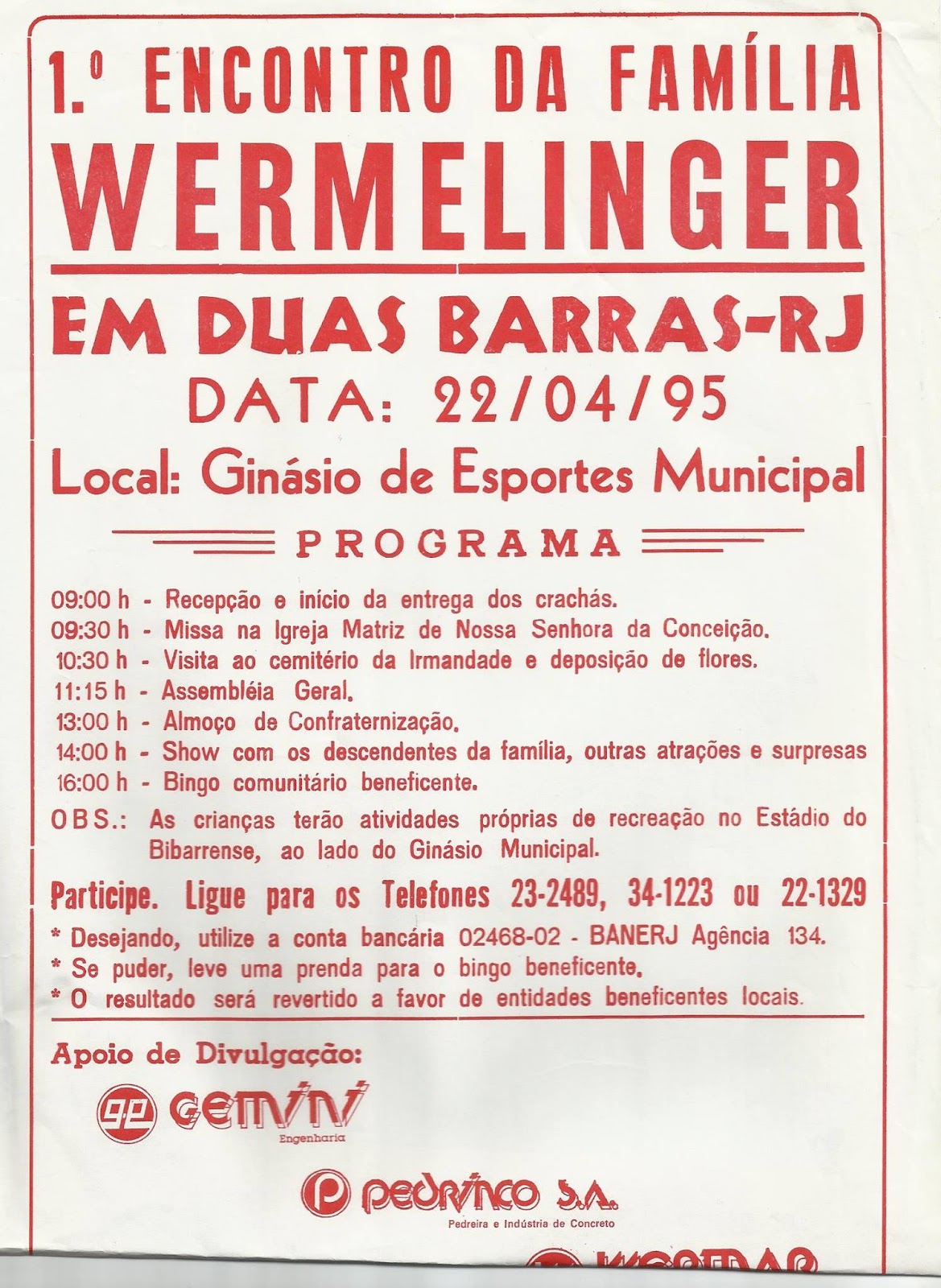
Convite original do 1º Encontro — Duas Barras, 1995
Originaleinladung zum 1. Treffen — Duas Barras, 1995
Original invitation to the 1st Gathering — Duas Barras, 1995
Tiago Torres Wermelinger
Duas Barras, Rio de Janeiro · Abril de 2026
Trinta e um anos depois daquela tarde de outono
Duas Barras, Rio de Janeiro · April 2026
Einunddreissig Jahre nach jenem Herbstnachmittag
Duas Barras, Rio de Janeiro · April 2026
Thirty-one years after that autumn afternoon
Publicado em três idiomas · PT · DE · EN
In drei Sprachen veröffentlicht · PT · DE · EN
Published in three languages · PT · DE · EN


