Crônica · Memórias do interior · Cooperativa
Chronik · Erinnerungen aus dem Hinterland · Genossenschaft
Chronicle · Memories from the countryside · Cooperative
Crônica escrita em 19 de maio de 2025 · Duas Barras, RJ
Geschrieben am 19. Mai 2025 · Duas Barras, RJ
Written on 19 May 2025 · Duas Barras, RJ
Sobrou um prédio — elegia à Cooperativa Agropecuária de Duas Barras
Übrig blieb ein Gebäude — Elegie auf die Landwirtschaftsgenossenschaft von Duas Barras
A building remained — elegy for the Agricultural Cooperative of Duas Barras
Cooperativa Agropecuária de Duas Barras — fatos confirmados
Landwirtschaftsgenossenschaft von Duas Barras — bestätigt
Agricultural Cooperative of Duas Barras — confirmed
Inaugurada em 1º de maio de 1970 · Dia do Trabalho
Presidências reconduzidas: Manoel Godofredo Wermelinger e Victorino Araujo de Barros
Inauguração com a presença do Governador Geremias de Mattos Fontes
Eingeweiht am 1. Mai 1970 · Tag der Arbeit
Mehrfach wiedergewählte Präsidenten: Manoel Godofredo Wermelinger und Victorino Araujo de Barros
Einweihung in Anwesenheit des Gouverneurs Geremias de Mattos Fontes
Inaugurated on 1 May 1970 · Labor Day
Re-elected Presidents: Manoel Godofredo Wermelinger and Victorino Araujo de Barros
Inauguration with the presence of Governor Geremias de Mattos Fontes
“Sobrou um nome grafado no concreto: COOPERATIVA. Desgastado, sim. Mas ainda ali. Como quem resiste à própria extinção.”
„Übrig blieb ein Name in Beton geschrieben: GENOSSENSCHAFT. Verwittert, ja. Aber noch da. Wie einer, der seinem eigenen Ende widersteht.“
“A name remained, written in concrete: COOPERATIVE. Worn, yes. But still there. Like one who resists its own extinction.”
do poema — 19 de maio de 2025
aus dem Gedicht — 19. Mai 2025
from the poem — 19 May 2025
Nota de método · versão 2.2
Methodische Anmerkung · Version 2.2
Note on method · version 2.2
Este post tem três camadas. Primeiro, o poema em português, escrito numa única vez em 19 de maio de 2025 e aqui reproduzido sem alteração de uma única vírgula. Segundo, versões poéticas em alemão e em inglês, escritas pelo próprio autor: adaptações do gesto, do ritmo e do som. Terceiro, um contexto histórico sobre Manoel Godofredo Wermelinger e sobre a Cooperativa Agropecuária de Duas Barras. Esta é a versão 2.2, atualizada após dois testemunhos escritos consecutivos de Amilton José Wermelinger de Araujo, ele próprio retratado na fotografia ao lado de Godofredo. O segundo testemunho identificou os oito retratados, descreveu a ocasião (visita do Governador à obra ainda em construção), confirmou as reconduções de Manoel Godofredo e Victorino Araujo de Barros à Presidência da entidade, e abriu uma nova frente sobre as figuras do cotidiano operacional — Plínio Roberti Wermelinger e José Tadeu de Oliveira (Tadeuzinho) — que merecerá crônica-irmã. Permanecem em pesquisa o ato constitutivo formal, o estatuto, e a data efetiva do encerramento operacional.
Dieser Beitrag hat drei Ebenen. Erstens: das portugiesische Gedicht, am 19. Mai 2025 in einem Zug geschrieben und hier ohne ein einziges Komma der Veränderung wiedergegeben. Zweitens: poetische Fassungen auf Deutsch und Englisch, vom Autor selbst verfasst: Adaptionen der Geste, des Rhythmus und des Klangs. Drittens: ein historischer Rahmen über Manoel Godofredo Wermelinger und die Landwirtschaftsgenossenschaft von Duas Barras. Dies ist Version 2.2, aktualisiert nach zwei aufeinanderfolgenden schriftlichen Zeugnissen von Amilton José Wermelinger de Araujo, der selbst auf der Fotografie an der Seite von Godofredo abgebildet ist. Das zweite Zeugnis identifizierte die acht Abgebildeten, beschrieb den Anlass (Besuch des Gouverneurs auf der noch in Bau befindlichen Anlage), bestätigte die Wiederwahlen von Manoel Godofredo und Victorino Araujo de Barros zum Präsidenten der Einrichtung und eröffnete eine neue Front zu den Persönlichkeiten des operativen Alltags — Plínio Roberti Wermelinger und José Tadeu de Oliveira (Tadeuzinho) —, die einer Schwesterchronik vorbehalten bleibt. Offen bleiben der formelle Gründungsakt, das Statut und das tatsächliche Datum der Betriebseinstellung.
This post has three layers. First, the Portuguese poem, written in one sitting on 19 May 2025 and reproduced here without altering a single comma. Second, poetic versions in German and English, written by the author himself: adaptations of gesture, rhythm and sound. Third, a historical frame on Manoel Godofredo Wermelinger and the Agricultural Cooperative of Duas Barras. This is version 2.2, updated after two successive written testimonies from Amilton José Wermelinger de Araujo, himself portrayed in the photograph beside Godofredo. The second testimony identified the eight men in the photograph, described the occasion (the Governor's visit to the construction site), confirmed the re-elections of Manoel Godofredo and Victorino Araujo de Barros to the Presidency of the entity, and opened a new front on the figures of the operational daily life — Plínio Roberti Wermelinger and José Tadeu de Oliveira (Tadeuzinho) — which will be reserved for a sister chronicle. Pending research: the formal founding act, the statute, and the effective date of operational closure.
Em maio de 2025, voltando entre Duas Barras e Cantagalo, parei numa curva onde sempre tinha passado de olhos meio fechados. O prédio estava ali, à beira da estrada. Cimento descascado, telha quebrada, mato subindo pelo concreto. Não havia placa, não havia ninguém. Mas no alto da fachada, ainda legível debaixo da poeira de décadas, o nome continuava escrito: COOPERATIVA. Voltei para casa naquela tarde e escrevi este texto numa hora só. Não revisei, não cortei, não acrescentei. Saiu como saiu.
Anos depois — agora, com a árvore da família mais clara, com uma fotografia recuperada do acervo dos antigos, e com testemunhos escritos de um parente — entendo que aquele prédio também era uma assinatura. Meu avô, Manoel Godofredo Wermelinger, esteve entre os homens que o ergueram em 1970. O texto que se segue é, portanto, dupla coisa: lamento de quem passa pela ruína, e gesto de quem reconhece a ruína como herança.
Sobrou um prédio.
Mas não é prédio — é fantasma.
Cimento cansado à beira da estrada
entre Duas Barras e Cantagalo.
Quem passa ali — correndo, andando, pedalando —
não vê só ruína.
Sente.
Sente o que foi deixado morrer.
Sente o que ainda pulsa —
e não teve quem o salvasse.
Sobrou a vergonha do que não foi feito.
A culpa muda dos que podiam — e não agiram.
Os sócios calaram.
A liderança sumiu.
E a Cooperativa, que era orgulho...
foi tombada sem velório.
Sobrou o leite sem análise,
o galpão sem canto,
e a balança — enferrujada —
que um dia pesou esperança.
Sobrou o cheiro da infância
nas lembranças de um menino levado pelo pai,
enquanto o avô assinava,
sonhando futuro com mãos de colono
e olhar de construtor.
Sobrou um nome grafado no concreto:
COOPERATIVA.
Desgastado, sim.
Mas ainda ali.
Como quem resiste à própria extinção.
Sobrou o lamento que ecoa na estrada,
nos olhos dos que ainda passam —
e nos que param.
Sobrou a cidade, fingindo pressa
pra não encarar o que virou espelho.
Mas também sobrou o sangue dos que lembram.
A palavra dos que não aceitam o esquecimento.
E um sussurro que insiste:
“Não deixem que o que era vivo vire só lembrança.
Não deixem que o nome vire só pedra.”
Porque a Cooperativa não morreu.
Ela apenas espera —
pelo gesto de quem ainda honra os antigos.
Pelo ato de quem ousa reerguer sem pedir permissão.
Pelo filho, pelo neto,
ou até por um estranho
que um dia decida:
“Aqui, algo justo precisa nascer de novo.”
Tiago Wermelinger · Duas Barras, 19 de maio de 2025
A fotografia — visita do Governador, c. 1970
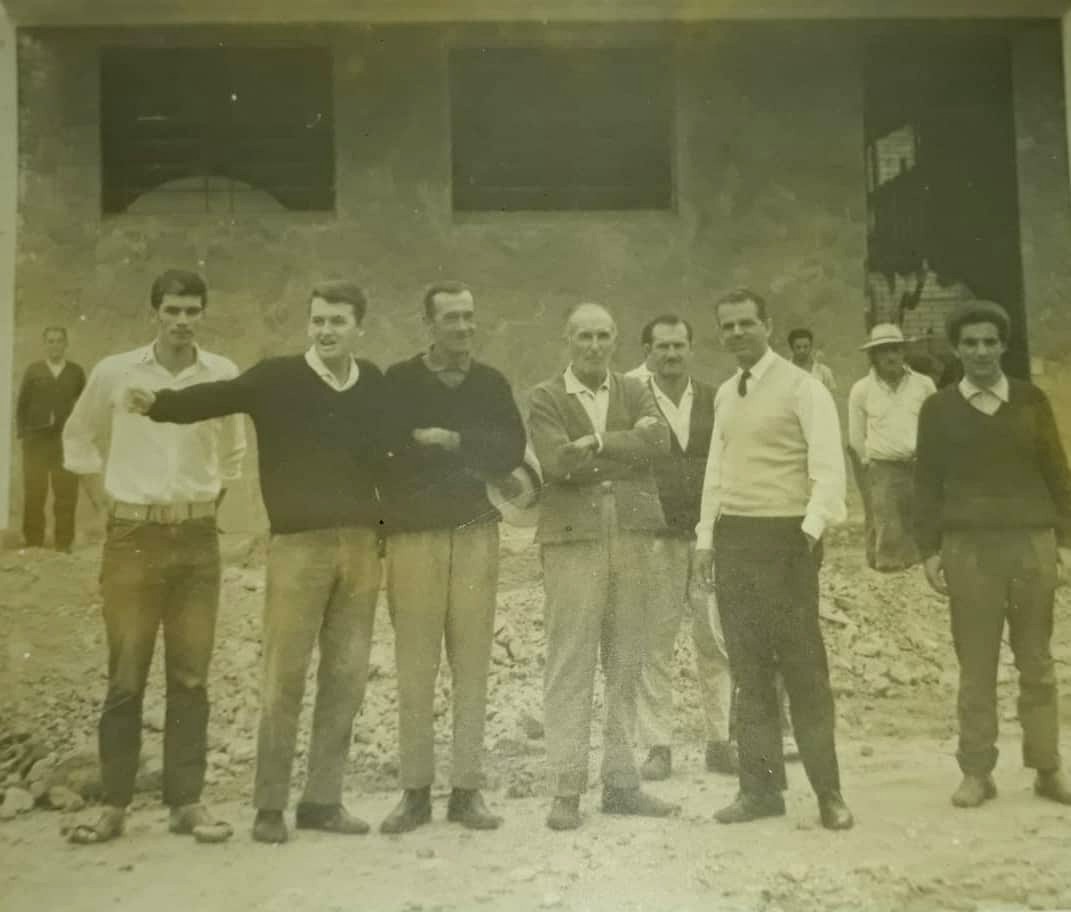
A foto recuperada do acervo da família mostra o prédio ainda no início da obra: paredes erguidas, janelas sem caixilho, terreno em barro. Em primeiro plano, oito homens posam para o registro — vestidos com formalidade incompatível com um dia de obra: camisas brancas, suéteres, sapatos de couro. Não é o registro do trabalho. É o registro de uma visita oficial, em que o Governador do Estado do Rio de Janeiro, Geremias de Mattos Fontes, foi recebido pelos articuladores do projeto da Cooperativa.
A identificação dos retratados foi feita por Amilton José Wermelinger de Araujo, em testemunho escrito ao autor deste arquivo. Amilton se reconheceu na foto, ao lado de Manoel Godofredo Wermelinger — ambos com o mesmo agasalho preto e calças de tonalidade aproximada. Naquele dia, segundo seu próprio relato, ele estava com cerca de vinte anos e tentava explicar ao Dr. Geremias e aos demais presentes o projeto global da Cooperativa. Era próximo de Manoel Godofredo e do tio Victorino, por laços de parentesco e amizade.
Os oito retratados em primeiro plano · da esquerda para a direita
- Geraldo de Oliveira Calvo
- Cláudio Celso da Câmara
- Amilton José Wermelinger de Araujo (testemunho)
- Manoel Godofredo Wermelinger (avô do autor)
- Victorino Araujo de Barros ('tio Victorino' no testemunho; parentesco a apurar)
- Mário de Araujo Rodrigues
- Governador Geremias de Mattos Fontes
- Antônio de Souza Turque
A imagem é mais do que um documento de arquivo. É a outra ponta do mesmo eixo geográfico que o poema descreve: o mesmo lugar, à beira da mesma estrada entre Duas Barras e Cantagalo, antes do silêncio. Cinquenta e cinco anos separam as duas fotografias deste post. Entre uma e outra cabe a vida inteira de uma instituição.
Aparentados até a medula
O testemunho do Amilton trouxe, junto com a identificação da foto, uma camada genealógica que o arquivo ainda não tinha consolidado. Eu e ele, descobre-se ali, somos parentes por dois lados ao mesmo tempo: pelo ramo Wermelinger e pelo ramo Erthal — este último entrando na família pela imigração alemã de Johann Erthal, que em 1824 desposou Catharina Wermelinger Erthal, filha de Franz Xaver e da matriarca Catharina Eggly. As duas Catharinas, mãe e filha, são matriarcas duplas. O Amilton resumiu o vínculo numa frase que vou repetir aqui inteira porque não há paráfrase que lhe faça justiça:
Éramos aparentados até a medula.
Amilton José Wermelinger de Araujo · testemunho escrito, maio de 2026
Na linguagem das fazendas dos antigos — Joseph e Stephann Wermelinger, em Boa Vista e em São Pedro; João Erthal, no Pacau; Johann Erthal e Catharina Wermelinger Erthal, em Bom Jardim — a similaridade física entre Godofredo e Amilton dava motivo de brincadeira. Os mais velhos, dizia o Amilton, vendo a parelha, mandavam cangar: aplicar a canga, formar a junta de bois para puxarem juntos. Era zombaria afetuosa, mas era também reconhecimento — o sangue que vinha pelos dois lados produzia um tipo só. E o vínculo seguia: Amilton tratava Victorino Araujo de Barros, sócio fundador da Cooperativa, por tio Victorino.
Esta camada merece post próprio
O vínculo Erthal–Wermelinger, articulado com tanta clareza no testemunho do Amilton, é tema denso demais para caber numa elegia da Cooperativa. Ficará para uma crônica-irmã —
O vínculo Erthal–Wermelinger: dois patriarcas, duas Catharinas, uma família única — em que o testemunho do Amilton será fonte primária citada com a extensão que merece. Aqui, basta deixar registrada a abertura.
O avô que assinou
Manoel Godofredo Wermelinger é da quarta geração, contada desde Franz Xaver, o tornedor de Willisau que desceu o Atlântico em 1819. A linha é direta: Franz Xaver → Stephan → Antônio → Manoel Godofredo → Luiz Gonzaga (meu pai) → eu. Godofredo é meu avô paterno. Foi colono nas terras altas entre Duas Barras e Cantagalo — sucessão de uma vocação agrícola que, nesse ramo da família, atravessa o século XIX inteiro e chega ao XX praticamente intacta.
Casou-se com Ritinha, filha de tia Marianna — e Marianna era irmã de Francisca Erthal Wermelinger, a Dona Chiquinha, avó do Amilton. O elo Erthal entra na minha linha por essa porta materna do meu avô, isto é, pela bisavó Marianna. Foi um dos sócios fundadores da Cooperativa Agropecuária de Duas Barras, ao lado dos demais cooperados cujos nomes ainda preciso recuperar nos cartórios e na Junta Comercial. Quando o poema diz “enquanto o avô assinava, sonhando futuro com mãos de colono e olhar de construtor” — isso é referência direta a um ato real: Godofredo entre os homens que firmaram o estatuto da Cooperativa, num dia entre o final dos anos 1960 e o início de 1970.
A Cooperativa Agropecuária de Duas Barras
A Cooperativa foi inaugurada em 1º de maio de 1970. A escolha da data não é detalhe lateral: é gesto. 1º de maio — Dia do Trabalho. Inaugurar uma cooperativa rural no Dia do Trabalho é declaração programática — a entidade se afirmava do lado dos pequenos produtores, do trabalho organizado, da renda partilhada. À cerimônia esteve presente o Governador do antigo Estado do Rio de Janeiro, Geremias de Mattos Fontes, cujo mandato se estendeu de 31 de janeiro de 1967 a 31 de março de 1971 e cuja administração foi reconhecidamente voltada para os municípios do interior, principalmente nas áreas de educação e saneamento.
A Cooperativa funcionou por décadas no eixo Duas Barras–Cantagalo. O movimento era simples e exato: cada produtor levava o leite no início do dia, a balança pesava, alguém anotava no caderno, depois vinha a análise — densidade, gordura, acidez. Esse caderno garantia a renda do mês de cada sítio pequeno. O galpão era ponto de encontro dos colonos da região, e por décadas funcionou como uma das instituições civis mais concretas que aquela faixa de serra teve.
Quando o sistema cooperativo nacional entrou em crise nas últimas décadas do século, e quando a liderança local não soube articular a transição, a estrutura foi sendo abandonada. Não houve assembleia formal de dissolução. Não houve velório. Apenas um esvaziamento gradual, depois um silêncio, depois o mato subindo pelo concreto. Em 2025, restava apenas o casco do prédio à beira da estrada — e o nome ainda gravado na fachada.
As figuras do cotidiano
A operação cotidiana — a balança, o caderno, o galpão — sustentou-se por décadas em pessoas cujos nomes pertencem ao mesmo arquivo que o do meu avô. Manoel Godofredo Wermelinger e Victorino Araujo de Barros foram reconduzidos várias vezes à Presidência da Cooperativa — figura institucional dupla, com vocação de continuidade. Plínio Roberti Wermelinger, parente igualmente próximo, foi por muitos anos seu Diretor Comercial e Financeiro — o homem que cuidava dos números e dos livros, função sem a qual nenhuma cooperativa atravessa décadas. José Tadeu de Oliveira, o Tadeuzinho, é descrito pelo Amilton como o homem que sustentava a carga do dia a dia, com integridade e honradez registradas por todos que com ele trabalharam — figura cuja passagem pela instituição deixou pegadas que ainda hoje se reconhecem.
O próprio Amilton, em seu testemunho, descreve o seu papel naquela articulação com sobriedade característica:
Eu ajudava a "carregar pedras", tarefa mais típica de meu estilo.
Amilton José Wermelinger de Araujo · testemunho escrito, maio de 2026
É autobiografia ética em uma linha. Cada uma dessas figuras — Plínio, Tadeuzinho, Amilton, e os demais que ainda preciso identificar — merece tratamento próprio. Não cabem dentro de uma elegia, e seria desrespeitoso comprimi-las. Virá em crônica-irmã: A Cooperativa por dentro: as pessoas que carregaram a pedra.
Linha do tempo da Cooperativa Agropecuária de Duas Barras
- final dos anos 1960 datação a fechararticulação inicial entre Manoel Godofredo Wermelinger, Victorino Araujo de Barros, Amilton José Wermelinger de Araujo (com cerca de 20 anos) e demais sócios fundadores; início da obra do prédio.
- c. 1970 — visita oficial fotofotografia da obra ainda em construção, durante visita do Governador Geremias de Mattos Fontes. Os oito retratados em primeiro plano identificados em testemunho do Amilton (2026).
- 1º de maio de 1970 confirmadoinauguração da Cooperativa Agropecuária de Duas Barras — Dia do Trabalho.
- décadas de 1970, 80, 90 testemunhooperação leiteira em pleno funcionamento. Manoel Godofredo e Victorino Araujo de Barros reconduzidos várias vezes à Presidência. Plínio Roberti Wermelinger atua como Diretor Comercial e Financeiro. José Tadeu de Oliveira (Tadeuzinho) sustenta o cotidiano operacional.
- final do século XX datação a fecharinício da decadência operacional, em paralelo à crise nacional do sistema cooperativo.
- data a confirmar pesquisa pendenteinterrupção de fato das atividades, sem assembleia formal de dissolução documentada.
- 19 de maio de 2025Tiago passa pelo prédio em ruínas e escreve, numa hora, “Sobrou um prédio”.
- 2026recuperação da fotografia da obra no acervo da família.
- maio de 2026 testemunhosAmilton José Wermelinger de Araujo, em duas comunicações sucessivas, identifica os retratados, reconstitui a ocasião da visita do Governador, confirma reconduções à Presidência e nomeia as figuras centrais da operação cotidiana.
O que este post ainda não trata em profundidade
Este texto é elegia, não inventário. A história institucional completa da Cooperativa — estatuto integral, ato constitutivo, atas de assembleia, livros de chamada de cooperados, dissolução jurídica formal (se houve) — permanece como pesquisa em aberto. Também permanece em aberto a relação entre essa Cooperativa e o circuito mais amplo de cooperativismo leiteiro fluminense da segunda metade do século XX. Esses pontos exigem texto próprio, fonte própria e cuidado próprio. Virão.
Por que isto fica registrado
O Arquivo Wermelinger não é apenas a árvore que sobe da Suíça de 1777 e atravessa 1819 para chegar às terras altas do Rio de Janeiro. Ele é também o que esses homens fizeram aqui depois — os atos pequenos, os atos cívicos, as assinaturas que sustentaram a vida coletiva por uma geração inteira. Godofredo entre os fundadores da Cooperativa Agropecuária de Duas Barras, em 1º de maio de 1970, é exatamente esse tipo de assinatura. E o testemunho do Amilton, em 2026, é o gesto inverso e simétrico — o do parente que confirma a memória, completa o rosto na foto, identifica os outros sete que estavam ali, e estende o vínculo familiar para um lado que ainda não estava fechado neste arquivo.
Que o prédio tenha sido deixado morrer não apaga a assinatura. A assinatura está agora aqui, no arquivo, com o nome inteiro — Manoel Godofredo Wermelinger — com o lugar e a data inteiros — Cooperativa Agropecuária de Duas Barras, 1º de maio de 1970 — com o parente ao lado, Amilton José Wermelinger de Araujo — e com os nomes dos que sustentaram o cotidiano: Plínio Roberti Wermelinger, José Tadeu de Oliveira, Victorino Araujo de Barros, e os demais que a pesquisa há de identificar. Até lá, o que sobra é o que já estava no concreto: um nome, uma data, uma elegia — e, agora, uma parelha, uma genealogia, um cotidiano.
Im Mai 2025, auf der Heimfahrt zwischen Duas Barras und Cantagalo, hielt ich an einer Kurve, die ich sonst halbblind passierte. Das Gebäude stand da, am Straßenrand. Abblätternder Beton, gebrochene Ziegel, Wildwuchs, der den Beton hinaufkroch. Kein Schild, niemand. Doch oben an der Fassade, unter dem Staub von Jahrzehnten noch lesbar, blieb der Name geschrieben: GENOSSENSCHAFT. Ich kam nach Hause und schrieb diesen Text in einer Stunde. Ich habe ihn nicht überarbeitet, nichts gestrichen, nichts hinzugefügt. So wie er kam, blieb er.
Jahre später — jetzt, mit klarerem Stammbaum, mit einer aus dem Familienarchiv wiedergefundenen Aufnahme und mit schriftlichen Zeugnissen eines Verwandten — verstehe ich, dass jenes Gebäude auch eine Unterschrift war. Mein Großvater, Manoel Godofredo Wermelinger, gehörte zu den Männern, die es 1970 errichteten. Der folgende Text ist also zweierlei: Klage dessen, der an der Ruine vorbeigeht, und Geste dessen, der die Ruine als Erbe erkennt.
Übrig blieb ein Gebäude.
Aber kein Gebäude — ein Gespenst.
Müder Beton am Rand der Straße
zwischen Duas Barras und Cantagalo.
Wer dort vorbeikommt — laufend, gehend, radelnd —
sieht nicht nur Ruine.
Spürt.
Spürt, was sterben gelassen wurde.
Spürt, was noch pocht —
und niemanden hatte, der es rettete.
Übrig blieb die Scham des Unterlassenen.
Die stumme Schuld derer, die konnten — und nicht handelten.
Die Genossen schwiegen.
Die Führung verschwand.
Und die Genossenschaft, einst Stolz...
wurde gefällt ohne Totenwache.
Übrig blieb die Milch ohne Prüfung,
der Schuppen ohne Lied,
und die Waage — verrostet —
die einst Hoffnung wog.
Übrig blieb der Duft der Kindheit
in den Erinnerungen eines Jungen, vom Vater mitgenommen,
während der Großvater unterschrieb,
Zukunft träumend mit Siedlerhänden
und Erbauerblick.
Übrig blieb ein Name in Beton geschrieben:
GENOSSENSCHAFT.
Verwittert, ja.
Aber noch da.
Wie einer, der seinem eigenen Ende widersteht.
Übrig blieb die Klage, die auf der Straße widerhallt,
in den Augen derer, die noch vorbeigehen —
und derer, die anhalten.
Übrig blieb die Stadt, Eile vortäuschend,
um nicht anzusehen, was zum Spiegel wurde.
Doch übrig blieb auch das Blut derer, die erinnern.
Das Wort derer, die das Vergessen nicht hinnehmen.
Und ein Flüstern, das beharrt:
„Lasst nicht zu, dass das Lebendige nur Erinnerung wird.
Lasst nicht zu, dass der Name nur Stein wird.“
Denn die Genossenschaft ist nicht tot.
Sie wartet nur —
auf die Geste dessen, der die Alten noch ehrt.
Auf die Tat dessen, der wagt — ohne um Erlaubnis zu bitten — neu aufzubauen.
Auf den Sohn, auf den Enkel,
oder gar auf einen Fremden,
der eines Tages entscheidet:
„Hier muss etwas Gerechtes neu geboren werden.“
Tiago Wermelinger · Duas Barras, 19. Mai 2025
Die Aufnahme — Besuch des Gouverneurs, um 1970
Die aus dem Familienarchiv geborgene Aufnahme zeigt das Gebäude noch zu Baubeginn: aufgerichtete Mauern, Fenster ohne Rahmen, lehmiger Bauplatz. Im Vordergrund posieren acht Männer für das Bild — gekleidet in einer Förmlichkeit, die unvereinbar ist mit einem Arbeitstag: weiße Hemden, Pullover, Lederschuhe. Es ist nicht das Bild der Arbeit. Es ist das Bild eines offiziellen Besuchs, bei dem der Gouverneur des Bundesstaates Rio de Janeiro, Geremias de Mattos Fontes, von den Initiatoren des Genossenschaftsprojekts empfangen wurde.
Die Identifikation der Abgebildeten erfolgte durch Amilton José Wermelinger de Araujo, in einem schriftlichen Zeugnis. Amilton erkannte sich selbst auf der Fotografie, an der Seite von Manoel Godofredo Wermelinger — beide in derselben schwarzen Strickjacke und in Hosen ähnlicher Tönung. An jenem Tag, so sein eigener Bericht, war er etwa zwanzig Jahre alt und versuchte, Dr. Geremias und den weiteren Anwesenden das Gesamtprojekt der Genossenschaft zu erläutern. Er stand Manoel Godofredo und dem Onkel Victorino nahe, durch Verwandtschaft und Freundschaft.
Die acht Abgebildeten im Vordergrund · von links nach rechts
- Geraldo de Oliveira Calvo
- Cláudio Celso da Câmara
- Amilton José Wermelinger de Araujo (Zeugnis)
- Manoel Godofredo Wermelinger (Großvater des Autors)
- Victorino Araujo de Barros ('Onkel Victorino' im Zeugnis; Verwandtschaftsgrad zu klären)
- Mário de Araujo Rodrigues
- Gouverneur Geremias de Mattos Fontes
- Antônio de Souza Turque
Das Bild ist mehr als ein Archivdokument. Es ist das andere Ende derselben geographischen Achse, die das Gedicht beschreibt: derselbe Ort, am Rand derselben Straße zwischen Duas Barras und Cantagalo, vor der Stille. Fünfundfünfzig Jahre trennen die beiden Aufnahmen dieses Beitrags. Dazwischen liegt das ganze Leben einer Einrichtung.
Verwandt bis ins Mark
Das Zeugnis Amiltons brachte zusammen mit der Identifikation der Aufnahme eine genealogische Schicht, die das Archiv noch nicht konsolidiert hatte. Er und ich, so zeigt sich dort, sind Verwandte auf zwei Seiten zugleich: über den Wermelinger-Zweig und über den Erthal-Zweig — letzterer kam in die Familie durch die deutsche Einwanderung von Johann Erthal, der 1824 Catharina Wermelinger Erthal heiratete, Tochter von Franz Xaver und der Matriarchin Catharina Eggly. Die beiden Catharinas, Mutter und Tochter, sind doppelte Matriarchinnen. Amilton fasste die Verbindung in einem Satz, den ich hier ungekürzt wiedergebe, weil keine Paraphrase ihm gerecht wird:
Wir waren verwandt bis ins Mark.
Amilton José Wermelinger de Araujo · schriftliches Zeugnis, Mai 2026
In der Sprache der Höfe der Alten — Joseph und Stephann Wermelinger, in Boa Vista und São Pedro; João Erthal, im Pacau; Johann Erthal und Catharina Wermelinger Erthal, in Bom Jardim — gab die körperliche Ähnlichkeit zwischen Godofredo und Amilton Anlass zu Scherz. Die Älteren, so Amilton, sahen das Gespann und befahlen cangar: das Joch anlegen, das Ochsenpaar bilden, damit sie zusammen ziehen. Es war herzliche Neckerei, aber zugleich Anerkennung — das Blut, das von beiden Seiten kam, brachte einen einzigen Typ hervor. Und die Verbindung setzte sich fort: Amilton sprach Victorino Araujo de Barros, das Gründungsmitglied der Genossenschaft, als Onkel Victorino an.
Diese Schicht verdient einen eigenen Beitrag
Die Verbindung Erthal–Wermelinger, in Amiltons Zeugnis so klar artikuliert, ist zu dicht, um in eine Genossenschaftselegie zu passen. Sie bleibt einer Schwesterchronik vorbehalten —
Die Verbindung Erthal–Wermelinger: zwei Patriarchen, zwei Catharinas, eine einzige Familie — in der Amiltons Zeugnis als Primärquelle in der ihm zustehenden Ausführlichkeit zitiert wird. Hier genügt, die Tür zu öffnen.
Der Großvater, der unterschrieb
Manoel Godofredo Wermelinger gehört zur vierten Generation, gezählt von Franz Xaver, dem Drechsler aus Willisau, der 1819 den Atlantik herabkam. Die Linie ist direkt: Franz Xaver → Stephan → Antônio → Manoel Godofredo → Luiz Gonzaga (mein Vater) → ich. Godofredo ist mein väterlicher Großvater. Er war Siedler im Hochland zwischen Duas Barras und Cantagalo — Fortsetzung einer landwirtschaftlichen Berufung, die in diesem Familienzweig das gesamte 19. Jahrhundert durchquert und nahezu unversehrt im 20. ankommt.
Er heiratete Ritinha, Tochter von Tante Marianna — und Marianna war Schwester von Francisca Erthal Wermelinger, Dona Chiquinha, Großmutter Amiltons. Die Erthal-Verbindung tritt in meine Linie über diese mütterliche Tür meines Großvaters ein, also über die Urgroßmutter Marianna. Er gehörte zu den Gründungsmitgliedern der Landwirtschaftsgenossenschaft von Duas Barras.
Die Landwirtschaftsgenossenschaft von Duas Barras
Die Genossenschaft wurde am 1. Mai 1970 eingeweiht. Die Wahl des Datums ist kein Nebendetail: sie ist Geste. 1. Mai — Tag der Arbeit. Eine ländliche Genossenschaft am Tag der Arbeit einzuweihen, ist programmatische Erklärung. Bei der Feier war der Gouverneur des damaligen Bundesstaates Rio de Janeiro, Geremias de Mattos Fontes, anwesend, dessen Mandat sich vom 31. Januar 1967 bis zum 31. März 1971 erstreckte und dessen Verwaltung anerkannt den Hinterland-Gemeinden, vor allem in Bildung und Wassersanierung, gewidmet war.
Die Genossenschaft arbeitete über Jahrzehnte auf der Achse Duas Barras–Cantagalo. Die Bewegung war einfach und genau: jeder Produzent brachte am frühen Morgen die Milch, die Waage wog, jemand schrieb ins Heft, danach kam die Prüfung — Dichte, Fett, Säure. Dieses Heft sicherte das Monatseinkommen jedes kleinen Hofes.
Als das nationale Genossenschaftssystem in den letzten Jahrzehnten des Jahrhunderts in die Krise geriet, wurde die Struktur allmählich aufgegeben. Es gab keine formelle Auflösungsversammlung. Nur eine schrittweise Entleerung, dann eine Stille, dann das Wildwerden des Betons. 2025 blieb nur die Hülle des Gebäudes am Straßenrand.
Die Persönlichkeiten des Alltags
Der operative Alltag — die Waage, das Heft, der Schuppen — trug sich über Jahrzehnte durch Personen, deren Namen in dasselbe Archiv gehören wie der meines Großvaters. Manoel Godofredo Wermelinger und Victorino Araujo de Barros wurden mehrfach zum Präsidenten der Genossenschaft wiedergewählt — institutionelle Doppelfigur mit Berufung zur Kontinuität. Plínio Roberti Wermelinger, ebenfalls naher Verwandter, war über viele Jahre ihr Kaufmännischer und Finanzdirektor — der Mann, der Zahlen und Bücher führte, eine Funktion, ohne die keine Genossenschaft Jahrzehnte überdauert. José Tadeu de Oliveira, der Tadeuzinho, wird von Amilton als der Mann beschrieben, der die Last des Alltags trug, mit Integrität und Redlichkeit, die alle, die mit ihm arbeiteten, festhielten — eine Gestalt, deren Spuren in der Einrichtung noch heute erkennbar sind.
Amilton selbst beschreibt seine eigene Rolle in jener Zeit mit charakteristischer Nüchternheit:
Ich half, "Steine zu tragen", eine Aufgabe, die meinem Stil eher entspricht.
Amilton José Wermelinger de Araujo · schriftliches Zeugnis, Mai 2026
Es ist ethische Selbstdarstellung in einem Satz. Jede dieser Gestalten — Plínio, Tadeuzinho, Amilton und die weiteren, die ich noch identifizieren muss — verdient eigene Behandlung. Sie passen nicht in eine Elegie, und es wäre respektlos, sie zu verkürzen. Es kommt eine Schwesterchronik: Die Genossenschaft von innen: die Menschen, die den Stein trugen.
Was dieser Beitrag noch nicht in der Tiefe behandelt
Dieser Text ist Elegie, nicht Inventar. Die vollständige institutionelle Geschichte der Genossenschaft — vollständiges Statut, Gründungsakt, Versammlungsprotokolle, Mitgliederbücher, formaljuristische Auflösung (falls vorhanden) — bleibt offene Recherche. Sie kommt.
Warum dies festgehalten wird
Das Wermelinger-Archiv ist nicht nur der Stammbaum, der von der Schweiz von 1777 aufsteigt und 1819 durchquert, um in den Hochlanden von Rio de Janeiro anzukommen. Es ist auch das, was diese Männer hier danach taten — die kleinen Taten, die bürgerlichen Akte, die Unterschriften, die das kollektive Leben einer ganzen Generation getragen haben. Godofredo unter den Gründern der Landwirtschaftsgenossenschaft von Duas Barras, am 1. Mai 1970, ist genau diese Art von Unterschrift. Und Amiltons Zeugnis, 2026, ist die umgekehrte und symmetrische Geste — die des Verwandten, der das Gedächtnis bestätigt, das Gesicht auf dem Bild vervollständigt, die anderen sieben identifiziert und die Familienverbindung um eine Seite erweitert.
Dass das Gebäude sterben gelassen wurde, löscht die Unterschrift nicht aus. Die Unterschrift steht jetzt hier, im Archiv, mit dem ganzen Namen, dem ganzen Ort, dem ganzen Datum — und mit den Namen derer, die den Alltag trugen: Plínio Roberti Wermelinger, José Tadeu de Oliveira, Victorino Araujo de Barros, und der weiteren, die die Recherche noch identifizieren wird. Bis dahin bleibt: ein Name, ein Datum, eine Elegie — und nun eine Gespanns-Bildung, eine Genealogie, ein Alltag.
In May 2025, driving back between Duas Barras and Cantagalo, I stopped at a curve I had always passed half-blind. The building was there, by the roadside. Peeling concrete, broken tiles, weeds climbing the walls. No sign, no one. Yet high on the façade, still legible under decades of dust, the name remained written: COOPERATIVE. I came home that afternoon and wrote this text in one hour. I did not revise, did not cut, did not add. It came as it came.
Years later — now, with the family tree clearer, with a photograph recovered from the elders' archive, and with written testimonies from a relative — I understand that the building was also a signature. My grandfather, Manoel Godofredo Wermelinger, was among the men who raised it in 1970. What follows is therefore double: the lament of one who passes the ruin, and the gesture of one who recognizes the ruin as inheritance.
A building remained.
But not a building — a ghost.
Tired concrete by the roadside
between Duas Barras and Cantagalo.
Whoever passes there — running, walking, cycling —
sees not only ruin.
Feels.
Feels what was let die.
Feels what still beats —
and had no one to save it.
What remained was the shame of what was not done.
The mute guilt of those who could — and did not act.
The members fell silent.
The leadership vanished.
And the Cooperative, once pride...
was felled without a wake.
What remained was milk without testing,
the shed without song,
and the scale — rusted —
that once weighed hope.
What remained was the scent of childhood
in the memories of a boy taken by his father,
while the grandfather signed,
dreaming the future with settler's hands
and a builder's gaze.
What remained was a name written in concrete:
COOPERATIVE.
Worn, yes.
But still there.
Like one who resists its own extinction.
What remained was the lament echoing on the road,
in the eyes of those who still pass —
and those who stop.
What remained was the town, faking haste,
so as not to face what became a mirror.
But what also remained was the blood of those who remember.
The word of those who do not accept forgetting.
And a whisper that insists:
“Do not let what was alive become only memory.
Do not let the name become only stone.”
For the Cooperative did not die.
It only waits —
for the gesture of one who still honors the old ones.
For the act of one who dares to rebuild without asking permission.
For the son, for the grandson,
or even for a stranger,
who one day decides:
“Here, something just must be born again.”
Tiago Wermelinger · Duas Barras, 19 May 2025
The photograph — the Governor's visit, c. 1970
The photograph recovered from the family archive shows the building still at the start of construction: walls raised, windows without frames, ground in mud. In the foreground, eight men pose for the record — dressed with a formality incompatible with a workday: white shirts, sweaters, leather shoes. This is not the record of the labor. It is the record of an official visit, in which the Governor of the State of Rio de Janeiro, Geremias de Mattos Fontes, was received by the project's articulators.
The identification of those portrayed was made by Amilton José Wermelinger de Araujo, in a written testimony to the author of this archive. Amilton recognized himself in the photograph, beside Manoel Godofredo Wermelinger — both wearing the same black sweater and trousers of approximate tone. On that day, in his own account, he was about twenty years old and was trying to explain to Dr. Geremias and the others present the Cooperative's overall project. He was close to Manoel Godofredo and to uncle Victorino, by ties of kinship and friendship.
The eight men in the foreground · left to right
- Geraldo de Oliveira Calvo
- Cláudio Celso da Câmara
- Amilton José Wermelinger de Araujo (testimony)
- Manoel Godofredo Wermelinger (author's grandfather)
- Victorino Araujo de Barros ('uncle Victorino' in the testimony; degree of kinship to be confirmed)
- Mário de Araujo Rodrigues
- Governor Geremias de Mattos Fontes
- Antônio de Souza Turque
The image is more than an archival document. It is the other end of the same geographical axis the poem describes: the same place, by the side of the same road between Duas Barras and Cantagalo, before the silence. Fifty-five years separate the two photographs in this post. Between one and the other lies the entire life of an institution.
Kin to the marrow
Amilton's testimony brought, alongside the identification of the photograph, a genealogical layer the archive had not yet consolidated. He and I, it turns out, are relatives on two sides at once: through the Wermelinger branch and through the Erthal branch — the latter entering the family through the German immigration of Johann Erthal, who in 1824 married Catharina Wermelinger Erthal, daughter of Franz Xaver and the matriarch Catharina Eggly. The two Catharinas, mother and daughter, are double matriarchs. Amilton summed up the bond in a sentence I reproduce here in full because no paraphrase does it justice:
We were kin to the marrow.
Amilton José Wermelinger de Araujo · written testimony, May 2026
In the language of the elders' farms — Joseph and Stephann Wermelinger, in Boa Vista and São Pedro; João Erthal, in Pacau; Johann Erthal and Catharina Wermelinger Erthal, in Bom Jardim — the physical similarity between Godofredo and Amilton was cause for jest. The older men, Amilton wrote, seeing the pair, would order to cangar: to put on the yoke, to form the team of oxen that pulls together. It was affectionate teasing, but it was also recognition — the blood that came from both sides produced a single type. And the bond continued: Amilton addressed Victorino Araujo de Barros, the Cooperative's founding member, as uncle Victorino.
This layer deserves its own post
The Erthal–Wermelinger bond, articulated with such clarity in Amilton's testimony, is too dense to fit within an elegy of the Cooperative. It will remain for a sister chronicle —
The Erthal–Wermelinger bond: two patriarchs, two Catharinas, one single family — in which Amilton's testimony will be cited as a primary source with the depth it deserves. Here, it is enough to leave the door open.
The grandfather who signed
Manoel Godofredo Wermelinger belongs to the fourth generation, counted from Franz Xaver, the turner from Willisau who came down the Atlantic in 1819. The line is direct: Franz Xaver → Stephan → Antônio → Manoel Godofredo → Luiz Gonzaga (my father) → me. Godofredo is my paternal grandfather. He was a settler in the highlands between Duas Barras and Cantagalo — continuation of an agricultural vocation that, in this branch of the family, crosses the entire 19th century and reaches the 20th nearly intact.
He married Ritinha, daughter of aunt Marianna — and Marianna was sister of Francisca Erthal Wermelinger, Dona Chiquinha, Amilton's grandmother. The Erthal link enters my line through that maternal door of my grandfather, that is, through great-grandmother Marianna. He was one of the founding members of the Agricultural Cooperative of Duas Barras.
The Agricultural Cooperative of Duas Barras
The Cooperative was inaugurated on 1 May 1970. The choice of date is not a side detail: it is gesture. 1 May — Labor Day. To inaugurate a rural cooperative on Labor Day is a programmatic statement. The ceremony was attended by the Governor of the former state of Rio de Janeiro, Geremias de Mattos Fontes, whose mandate ran from 31 January 1967 to 31 March 1971.
The Cooperative operated for decades along the Duas Barras–Cantagalo axis. The motion was simple and exact: each producer brought milk early in the day, the scale weighed it, someone wrote in the ledger, then came the analysis — density, fat, acidity. That ledger secured each small farm's monthly income.
When the national cooperative system entered crisis in the final decades of the century, the structure was gradually abandoned. There was no formal dissolution assembly. Only a gradual emptying, then a silence, then the weeds climbing the concrete. By 2025, only the shell of the building remained by the roadside.
The figures of daily life
The daily operation — the scale, the ledger, the shed — was sustained for decades by people whose names belong to the same archive as my grandfather's. Manoel Godofredo Wermelinger and Victorino Araujo de Barros were re-elected several times to the Presidency of the Cooperative — an institutional double figure, with a vocation for continuity. Plínio Roberti Wermelinger, an equally close relative, was for many years its Commercial and Financial Director — the man who handled the numbers and the books, a function without which no cooperative survives decades. José Tadeu de Oliveira, Tadeuzinho, is described by Amilton as the man who carried the daily load, with integrity and honesty noted by all who worked with him — a figure whose passage through the institution left footprints still recognizable today.
Amilton himself, in his testimony, describes his own role at that time with characteristic sobriety:
I helped to "carry stones", a task more typical of my style.
Amilton José Wermelinger de Araujo · written testimony, May 2026
It is ethical autobiography in a single line. Each of these figures — Plínio, Tadeuzinho, Amilton, and the others I have yet to identify — deserves its own treatment. They do not fit within an elegy, and it would be disrespectful to compress them. A sister chronicle is coming: The Cooperative from within: the people who carried the stone.
What this post does not yet address in depth
This text is elegy, not inventory. The complete institutional history of the Cooperative — full charter, founding act, assembly minutes, member books, formal legal dissolution (if any) — remains open research. They will come.
Why this stays on the record
The Wermelinger Archive is not only the tree that rises from Switzerland of 1777 and crosses 1819 to reach the highlands of Rio de Janeiro. It is also what these men did here afterward — the small acts, the civic acts, the signatures that sustained collective life for an entire generation. Godofredo among the founders of the Agricultural Cooperative of Duas Barras, on 1 May 1970, is exactly that kind of signature. And Amilton's testimony, in 2026, is the inverse and symmetrical gesture — that of the relative who confirms the memory, completes the face in the photograph, identifies the other seven, and extends the family bond to a side that was not yet closed.
That the building was let die does not erase the signature. The signature is now here, in the archive, with the full name, the full place, the full date — and with the names of those who carried the daily load: Plínio Roberti Wermelinger, José Tadeu de Oliveira, Victorino Araujo de Barros, and the others research will yet identify. Until then, what remains: a name, a date, an elegy — and now a yoke-pair, a genealogy, a daily life.
Notas e fontes
Anmerkungen und Quellen
Notes and sources
-
Poema “Sobrou um prédio”, escrito por Tiago Torres Wermelinger em Duas Barras, RJ, em 19 de maio de 2025. Publicado originalmente no Facebook do autor naquela data; reproduzido aqui no Arquivo Wermelinger sem alteração.
Gedicht „Übrig blieb ein Gebäude“, verfasst von Tiago Torres Wermelinger in Duas Barras, RJ, am 19. Mai 2025. Erstveröffentlichung an jenem Tag auf dem Facebook-Profil des Autors; hier ohne Änderung wiedergegeben.
Poem “A building remained”, written by Tiago Torres Wermelinger in Duas Barras, RJ, on 19 May 2025. Originally published on the author's Facebook profile that day; reproduced here without alteration.
-
Versões em alemão e em inglês: adaptações poéticas do próprio autor (não traduções automáticas, não traduções literais), redigidas em 2026 para esta edição trilíngue.
Deutsche und englische Fassungen: poetische Adaptionen des Autors selbst, 2026 für diese dreisprachige Ausgabe verfasst.
German and English versions: the author's own poetic adaptations, written in 2026 for this trilingual edition.
-
Fotografia da obra (c. 1970): registro fotográfico da Cooperativa Agropecuária de Duas Barras no início da obra, em visita oficial do Governador Geremias de Mattos Fontes. Os oito retratados em primeiro plano (da esquerda para a direita): Geraldo de Oliveira Calvo, Cláudio Celso da Câmara, Amilton José Wermelinger de Araujo, Manoel Godofredo Wermelinger, Victorino Araujo de Barros, Mário de Araujo Rodrigues, Governador Geremias de Mattos Fontes, Antônio de Souza Turque. Acervo da família Wermelinger; recuperada em 2026.
Bauaufnahme (um 1970): fotografisches Zeugnis der Landwirtschaftsgenossenschaft von Duas Barras zu Baubeginn, beim offiziellen Besuch des Gouverneurs Geremias de Mattos Fontes. Die acht Abgebildeten im Vordergrund (von links nach rechts): Geraldo de Oliveira Calvo, Cláudio Celso da Câmara, Amilton José Wermelinger de Araujo, Manoel Godofredo Wermelinger, Victorino Araujo de Barros, Mário de Araujo Rodrigues, Gouverneur Geremias de Mattos Fontes, Antônio de Souza Turque. Familienarchiv Wermelinger; 2026 wiedergefunden.
Construction photograph (c. 1970): photographic record of the Agricultural Cooperative of Duas Barras at the start of construction, during an official visit by Governor Geremias de Mattos Fontes. The eight men portrayed in the foreground (left to right): Geraldo de Oliveira Calvo, Cláudio Celso da Câmara, Amilton José Wermelinger de Araujo, Manoel Godofredo Wermelinger, Victorino Araujo de Barros, Mário de Araujo Rodrigues, Governor Geremias de Mattos Fontes, Antônio de Souza Turque. Wermelinger family archive; recovered in 2026.
-
Testemunhos de Amilton José Wermelinger de Araujo (parente direto, então com cerca de vinte anos na fotografia): duas comunicações escritas sucessivas ao autor deste arquivo, maio de 2026. Primeiro testemunho: identifica-se a si mesmo na fotografia, ao lado de Manoel Godofredo Wermelinger, e estabelece o vínculo dupla Wermelinger–Erthal entre os ramos familiares (via Marianna, Dona Chiquinha, e a expressão rural cangar); cita as fazendas históricas dos antigos (Boa Vista, São Pedro, Pacau, Bom Jardim) e os patriarcas (Xaver Wermelinger e Catharina Eggly; Johann Erthal e Catharina Wermelinger Erthal). Segundo testemunho: identifica os oito retratados em primeiro plano da esquerda para a direita; descreve a ocasião como visita oficial do Governador Geremias de Mattos Fontes à obra ainda em construção; confirma as reconduções de Manoel Godofredo Wermelinger e Victorino Araujo de Barros à Presidência da Cooperativa; nomeia Plínio Roberti Wermelinger como Diretor Comercial e Financeiro durante muitos anos; nomeia José Tadeu de Oliveira (Tadeuzinho) como figura central da operação cotidiana. Textos integrais arquivados no Arquivo Wermelinger.
Zeugnisse von Amilton José Wermelinger de Araujo (direkter Verwandter, damals etwa zwanzig Jahre alt auf der Aufnahme): zwei aufeinanderfolgende schriftliche Mitteilungen an den Verfasser dieses Archivs, Mai 2026. Erstes Zeugnis: Selbstidentifikation auf der Fotografie an der Seite von Manoel Godofredo Wermelinger; Etablierung der doppelten Wermelinger–Erthal-Verwandtschaft zwischen den Familienzweigen; Erwähnung der historischen Höfe (Boa Vista, São Pedro, Pacau, Bom Jardim) und der Patriarchen. Zweites Zeugnis: Identifikation der acht Abgebildeten im Vordergrund von links nach rechts; Beschreibung des Anlasses als offizieller Besuch des Gouverneurs Geremias de Mattos Fontes; Bestätigung der Wiederwahlen von Manoel Godofredo Wermelinger und Victorino Araujo de Barros zum Präsidenten; Benennung von Plínio Roberti Wermelinger als langjährigem Kaufmännischen und Finanzdirektor und José Tadeu de Oliveira (Tadeuzinho) als zentraler Gestalt des operativen Alltags. Volltexte im Wermelinger-Archiv aufbewahrt.
Testimonies of Amilton José Wermelinger de Araujo (direct relative, then about twenty years old in the photograph): two successive written communications to the author of this archive, May 2026. First testimony: self-identification in the photograph beside Manoel Godofredo Wermelinger; establishment of the dual Wermelinger–Erthal kinship across the family branches; mention of the historical farms (Boa Vista, São Pedro, Pacau, Bom Jardim) and the patriarchs. Second testimony: identification of the eight men portrayed in the foreground left to right; description of the occasion as an official visit by Governor Geremias de Mattos Fontes; confirmation of the re-elections of Manoel Godofredo Wermelinger and Victorino Araujo de Barros to the Presidency; naming of Plínio Roberti Wermelinger as long-time Commercial and Financial Director and José Tadeu de Oliveira (Tadeuzinho) as a central figure of the operational daily life. Full texts preserved in the Wermelinger Archive.
-
Imagem da ruína (2025): registro fotográfico do prédio da antiga Cooperativa Agropecuária de Duas Barras, à beira da estrada entre Duas Barras e Cantagalo, em maio de 2025. Publicada originalmente junto ao poema.
Bild der Ruine (2025): fotografische Aufnahme des Gebäudes der früheren Landwirtschaftsgenossenschaft, am Straßenrand zwischen Duas Barras und Cantagalo, im Mai 2025.
Image of the ruin (2025): photographic record of the former Cooperative building, by the roadside between Duas Barras and Cantagalo, in May 2025.
-
Geremias de Mattos Fontes (São Gonçalo, 28 de junho de 1930 — Niterói, 2 de março de 2010): pastor, advogado e político brasileiro. Indicado pelo regime militar como Governador do antigo Estado do Rio de Janeiro, exerceu o cargo de 31 de janeiro de 1967 a 31 de março de 1971, pela ARENA. Sua administração foi reconhecidamente voltada para os municípios do interior, com ênfase em educação e saneamento. Fontes: Wikipédia; A Voz da Serra — obituário, 2010; Identidades do Rio — UFF.
Geremias de Mattos Fontes (São Gonçalo, 28. Juni 1930 — Niterói, 2. März 2010): brasilianischer Pastor, Anwalt und Politiker. Vom Militärregime als Gouverneur des damaligen Bundesstaates Rio de Janeiro eingesetzt, vom 31. Januar 1967 bis zum 31. März 1971 für die ARENA. Quellen: Wikipedia; A Voz da Serra; Identidades do Rio (UFF).
Geremias de Mattos Fontes (São Gonçalo, 28 June 1930 — Niterói, 2 March 2010): Brazilian pastor, lawyer, and politician. Appointed by the military regime as Governor of the former state of Rio de Janeiro, 31 January 1967 to 31 March 1971, for ARENA. Sources: Wikipedia; A Voz da Serra; Identidades do Rio (UFF).
-
Linhagem Wermelinger (Tiago): Franz Xaver Wermelinger (n. 22.10.1777, Willisau, Lucerna; chegou ao Brasil em 1819) → Stephan → Antônio → Manoel Godofredo (avô) → Luiz Gonzaga Silveira Wermelinger (pai) → Tiago Torres Wermelinger. Vínculo Erthal: Manoel Godofredo casou-se com Ritinha, filha de Marianna; Marianna era irmã de Francisca Erthal Wermelinger (Dona Chiquinha), avó de Amilton; ambas eram primas-irmãs de Manoel Godofredo. Fonte primária para a parte suíça: Geschlechter-Buch von Willisau, Franz Sidler, 1953 (DOI 10.5169/seals-718397). Fonte para a parte brasileira e Erthal: registros familiares + testemunhos do Amilton (2026).
Wermelinger-Linie (Tiago): Franz Xaver (geb. 22.10.1777, Willisau, Luzern; nach Brasilien 1819) → Stephan → Antônio → Manoel Godofredo (Großvater) → Luiz Gonzaga Silveira Wermelinger (Vater) → Tiago Torres Wermelinger. Erthal-Verbindung: Manoel Godofredo heiratete Ritinha, Tochter von Marianna; Marianna war Schwester von Francisca Erthal Wermelinger (Dona Chiquinha), Großmutter Amiltons. Hauptquelle Schweizer Teil: Geschlechter-Buch von Willisau, Sidler, 1953. Brasilianischer Teil und Erthal: Familienregister + Zeugnisse Amiltons (2026).
Wermelinger line (Tiago): Franz Xaver (b. 22 Oct 1777, Willisau, Lucerne; arrived Brazil 1819) → Stephan → Antônio → Manoel Godofredo (grandfather) → Luiz Gonzaga Silveira Wermelinger (father) → Tiago Torres Wermelinger. Erthal bond: Manoel Godofredo married Ritinha, daughter of Marianna; Marianna was sister of Francisca Erthal Wermelinger (Dona Chiquinha), Amilton's grandmother. Primary source for the Swiss segment: Geschlechter-Buch von Willisau, Sidler, 1953. Brazilian segment and Erthal: family records + Amilton's testimonies (2026).
-
Pesquisa pendente (versão 2.2): ato constitutivo formal e número de registro na Junta Comercial; estatuto integral; cronologia das reconduções de Manoel Godofredo Wermelinger e Victorino Araujo de Barros à Presidência; data efetiva do encerramento operacional; identificação dos demais sócios fundadores; biografias de Plínio Roberti Wermelinger e José Tadeu de Oliveira. Próximas frentes: cartórios e Junta Comercial de Duas Barras; entrevistas com Amilton José Wermelinger de Araujo (fonte viva); arquivos da família Wermelinger; descendentes dos demais cooperados.
Recherche in Bearbeitung (Version 2.2): formeller Gründungsakt und Registernummer; vollständiges Statut; Chronologie der Wiederwahlen von Manoel Godofredo Wermelinger und Victorino Araujo de Barros zum Präsidenten; tatsächliches Datum der Betriebseinstellung; Identifizierung der weiteren Gründungsmitglieder; Biographien von Plínio Roberti Wermelinger und José Tadeu de Oliveira. Nächste Schritte: Notariate und Junta Comercial von Duas Barras; Interviews mit Amilton José Wermelinger de Araujo.
Research pending (version 2.2): formal founding act and registration number; full statute; chronology of the re-elections of Manoel Godofredo Wermelinger and Victorino Araujo de Barros to the Presidency; effective date of operational closure; identification of the remaining founding members; biographies of Plínio Roberti Wermelinger and José Tadeu de Oliveira. Next fronts: notaries and Junta Comercial of Duas Barras; interviews with Amilton José Wermelinger de Araujo.
Esta é a versão 2.2 do post da Cooperativa, atualizada em maio de 2026 a partir do segundo testemunho de Amilton José Wermelinger de Araujo, que identificou os oito retratados em primeiro plano da fotografia (da esquerda para a direita), confirmou as reconduções de Manoel Godofredo e Victorino Araujo de Barros à Presidência, e nomeou as figuras centrais da operação cotidiana — Plínio Roberti Wermelinger e José Tadeu de Oliveira (Tadeuzinho). O poema permanece definitivo — não foi revisado em uma única vírgula. O post-irmão A Cooperativa por dentro: as pessoas que carregaram a pedra está em planejamento. Cada atualização é consignada explicitamente em nota de edição.
Dies ist Version 2.2 des Beitrags, aktualisiert im Mai 2026 nach dem zweiten Zeugnis von Amilton José Wermelinger de Araujo, der die acht im Vordergrund der Fotografie Abgebildeten identifizierte (von links nach rechts), die Wiederwahlen von Manoel Godofredo und Victorino Araujo de Barros zum Präsidenten bestätigte und die zentralen Gestalten des operativen Alltags benannte — Plínio Roberti Wermelinger und José Tadeu de Oliveira (Tadeuzinho). Das Gedicht bleibt endgültig. Der Schwesterbeitrag Die Genossenschaft von innen: die Menschen, die den Stein trugen ist in Vorbereitung.
This is version 2.2, updated in May 2026 from Amilton José Wermelinger de Araujo's second testimony, which identified the eight men in the photograph's foreground (left to right), confirmed the re-elections of Manoel Godofredo and Victorino Araujo de Barros to the Presidency, and named the central figures of operational daily life — Plínio Roberti Wermelinger and José Tadeu de Oliveira (Tadeuzinho). The poem remains definitive. The sister post The Cooperative from within: the people who carried the stone is in preparation.
Tiago Torres Wermelinger
Duas Barras, Rio de Janeiro · poema escrito em 19 de maio de 2025
edição trilíngue do Arquivo Wermelinger · versão 2.2 · maio de 2026
onde a memória é preservada, não esquecida
Duas Barras, Rio de Janeiro · Gedicht verfasst am 19. Mai 2025
dreisprachige Ausgabe des Wermelinger-Archivs · Version 2.2 · Mai 2026
wo Erinnerung bewahrt wird, nicht vergessen
Duas Barras, Rio de Janeiro · poem written on 19 May 2025
trilingual edition of the Wermelinger Archive · version 2.2 · May 2026
where memory is preserved, not forgotten
PT canônico · DE & EN — adaptações poéticas do autor · v2.2
PT kanonisch · DE & EN — poetische Adaptionen des Autors · v2.2
PT canonical · DE & EN — the author's poetic adaptations · v2.2